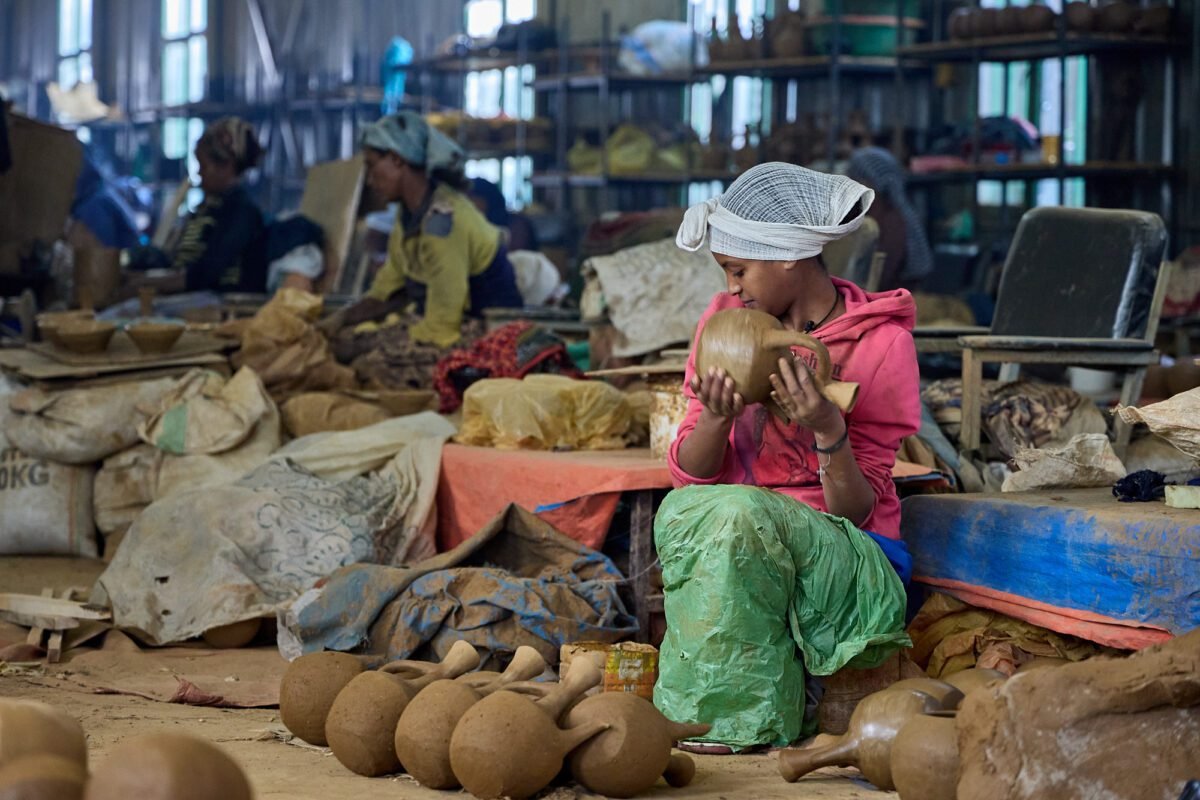
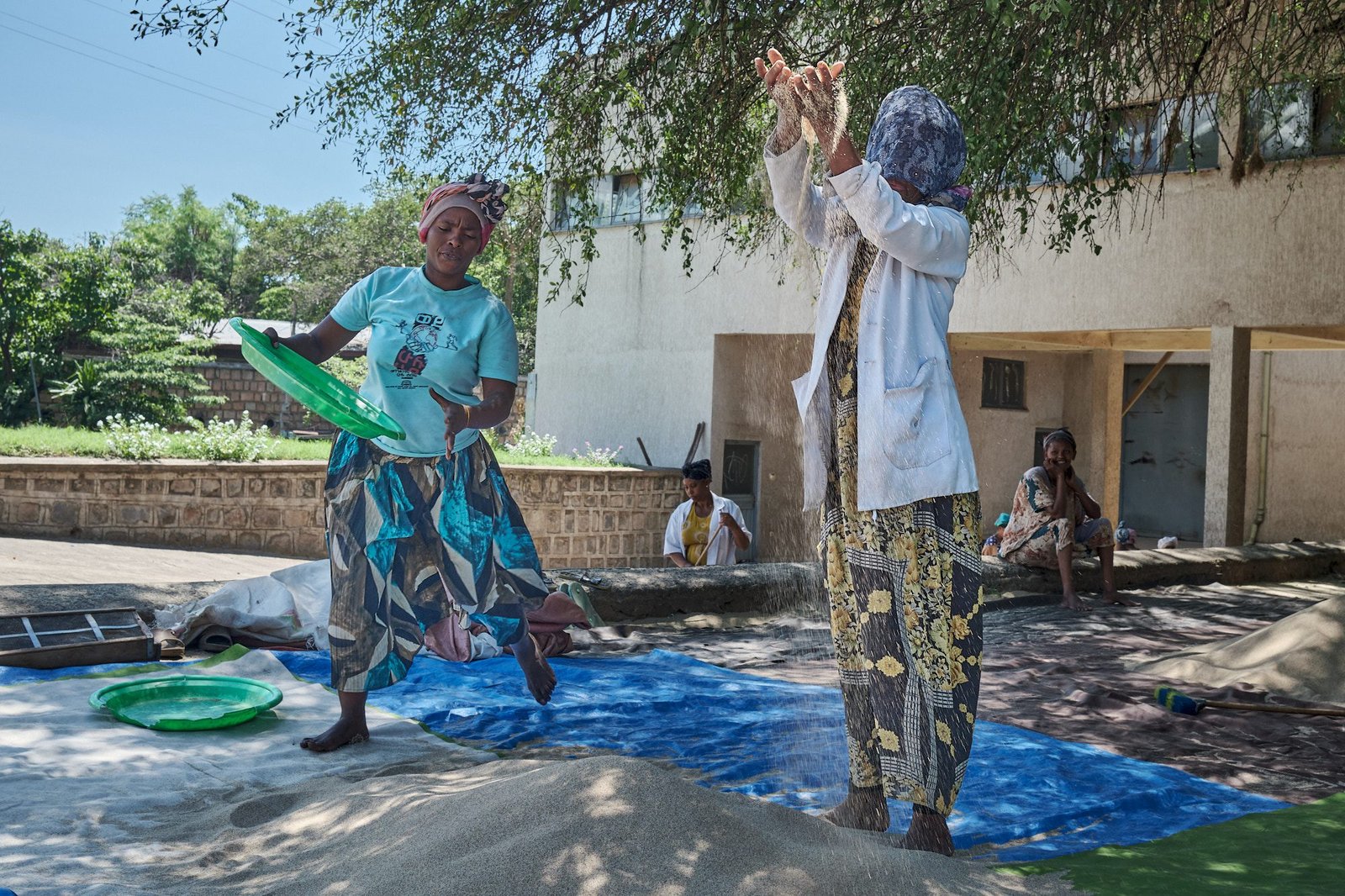
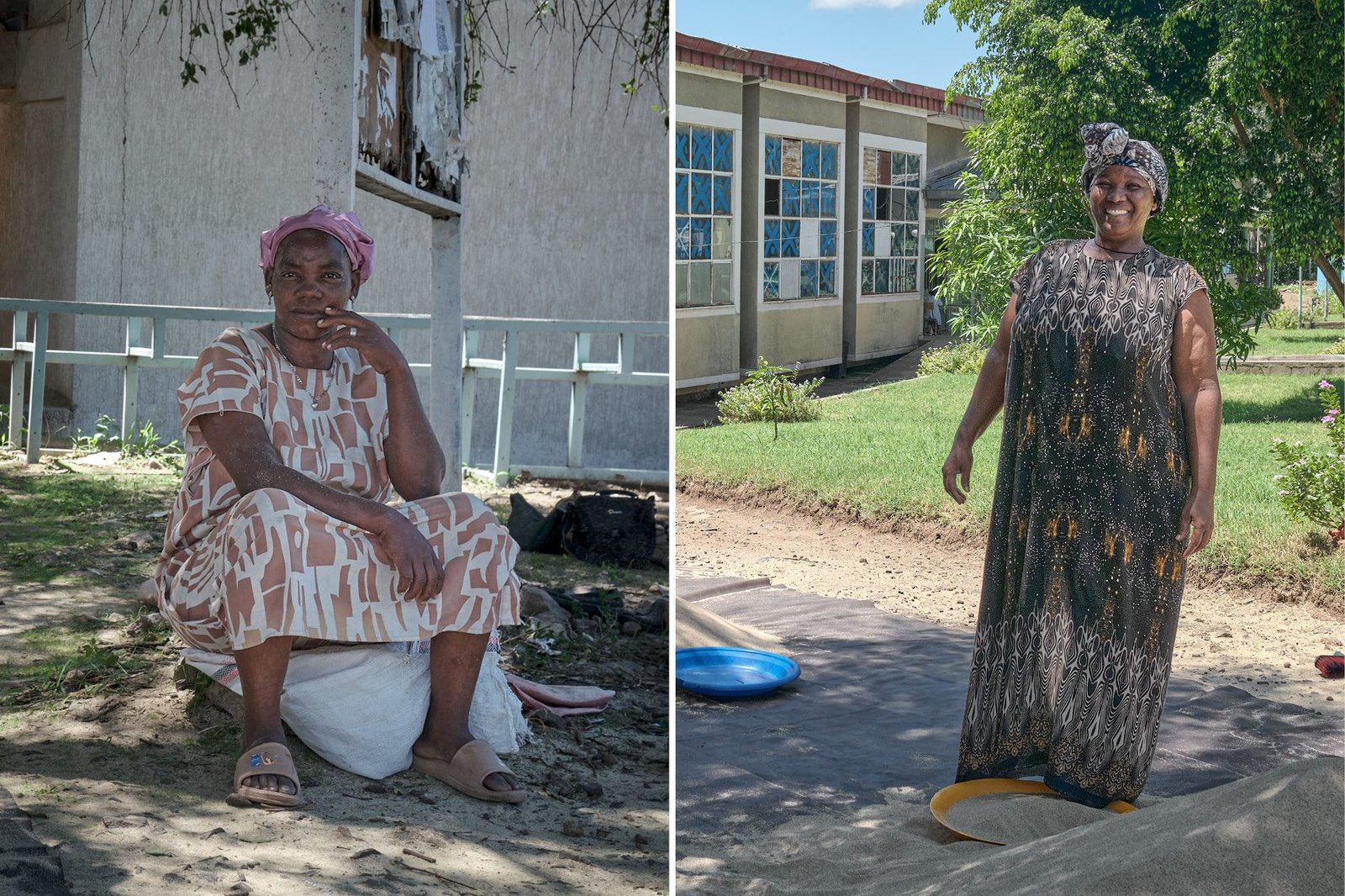
In Arba Minch, teff moves through hands, wooden sieves, plastic trays, shade, dust, and morning light. In these photographs by Ayzoh! photographer Giulia Zhang, women lift it, sift it, and let it fall in a shared outdoor space until the flour turns finer, cleaner, ready for the table. Before it becomes injera, teff passes through gesture, attention, and collective labor.
The grain in the air
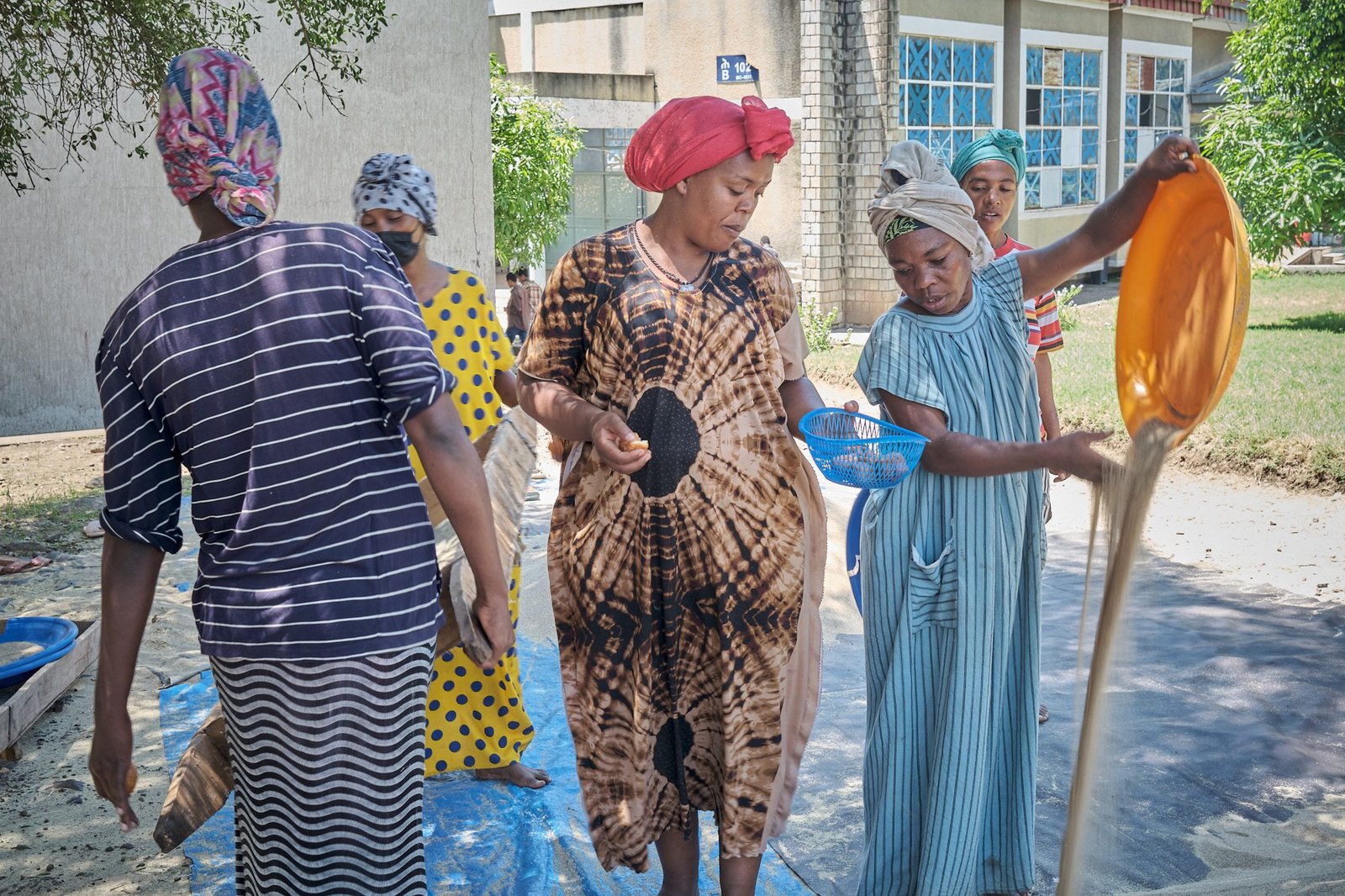
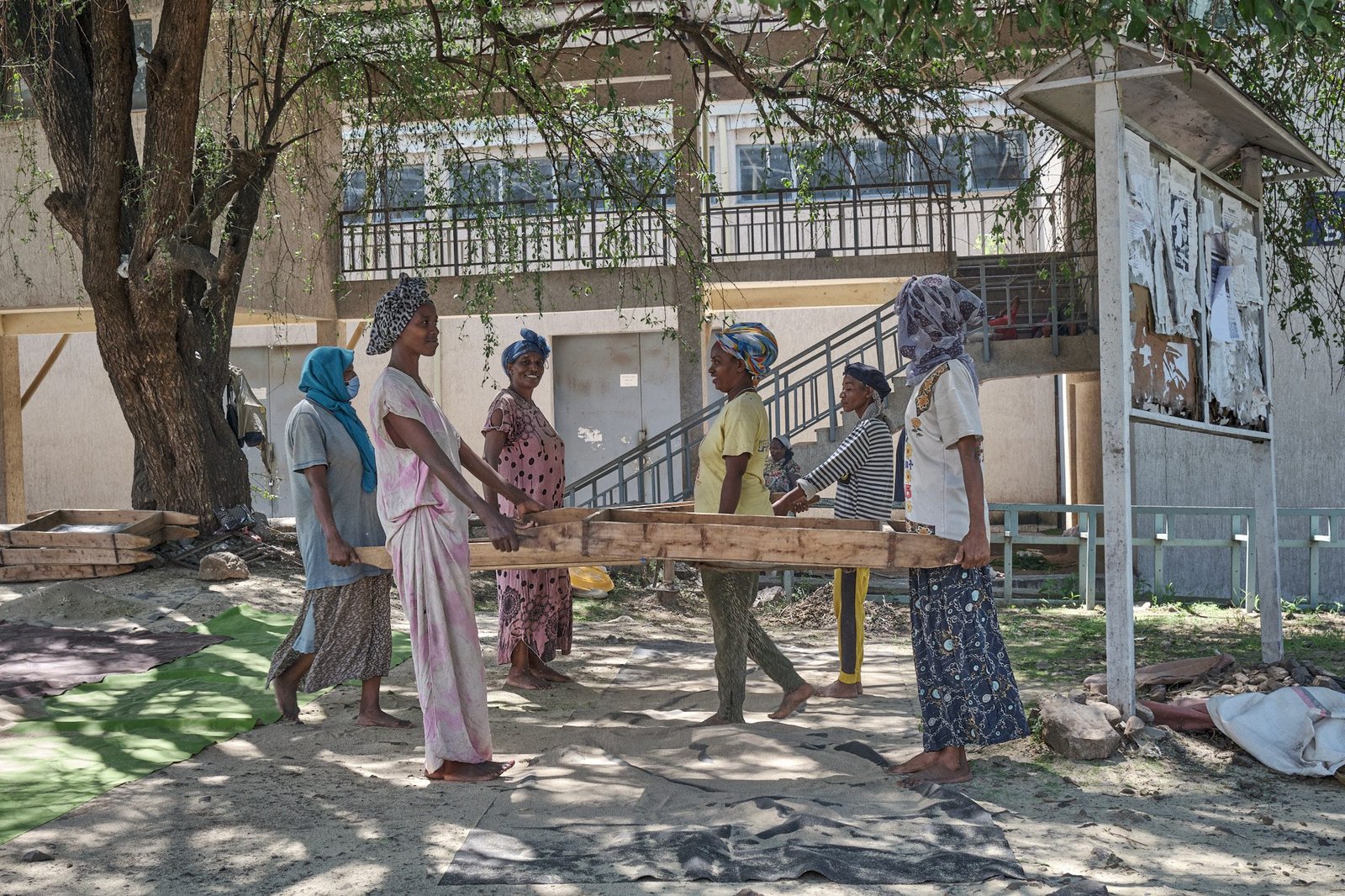
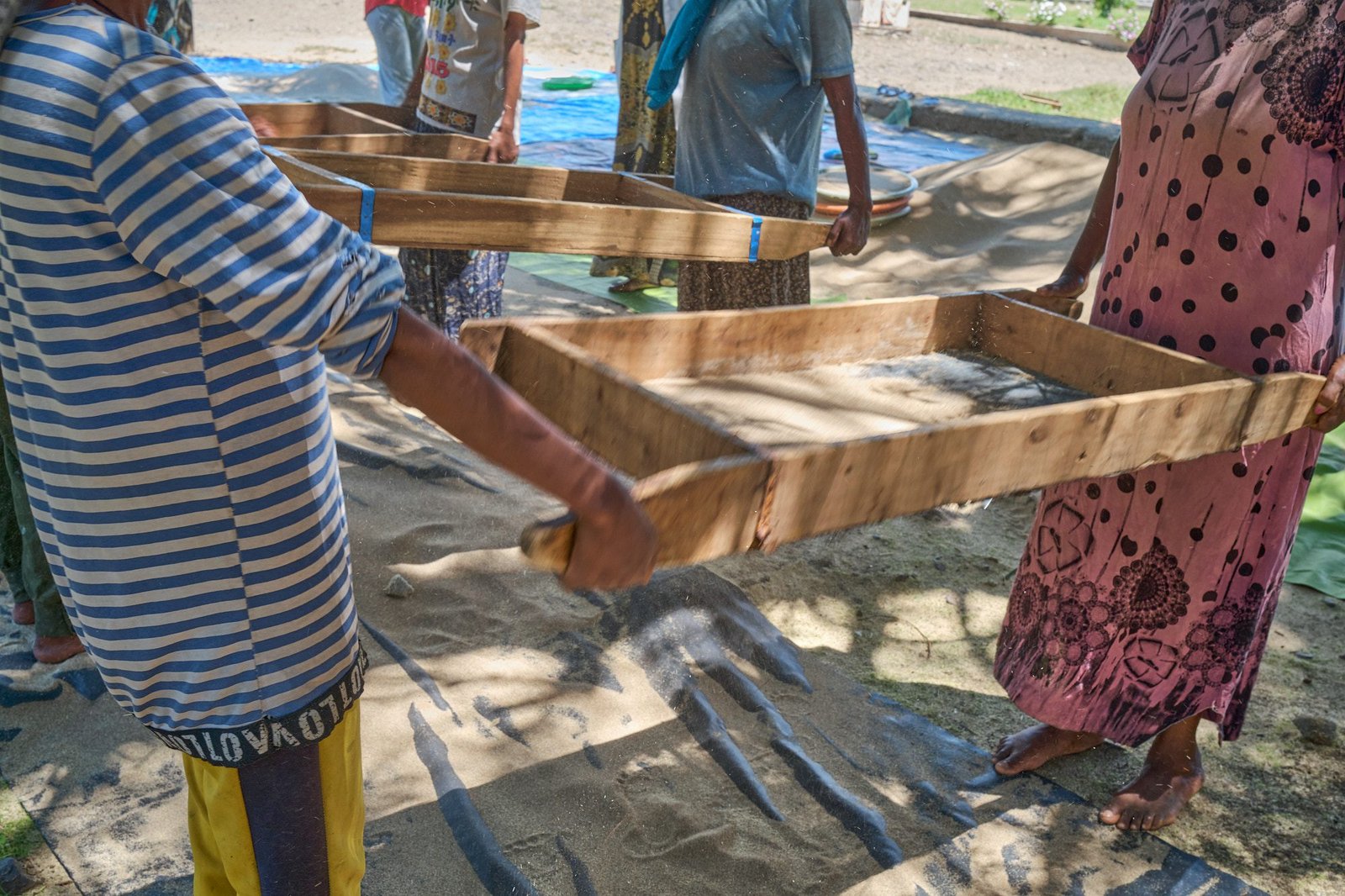
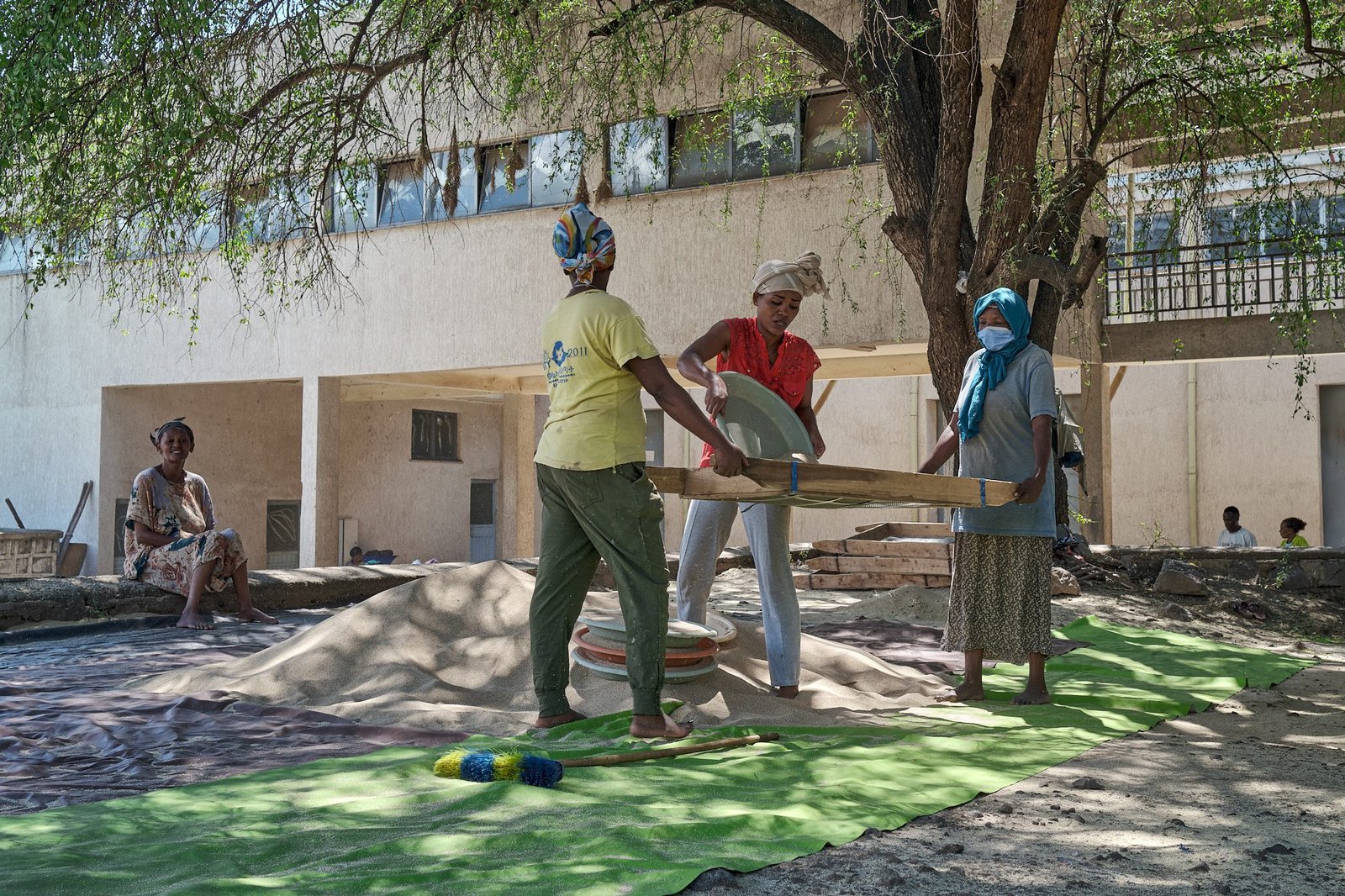
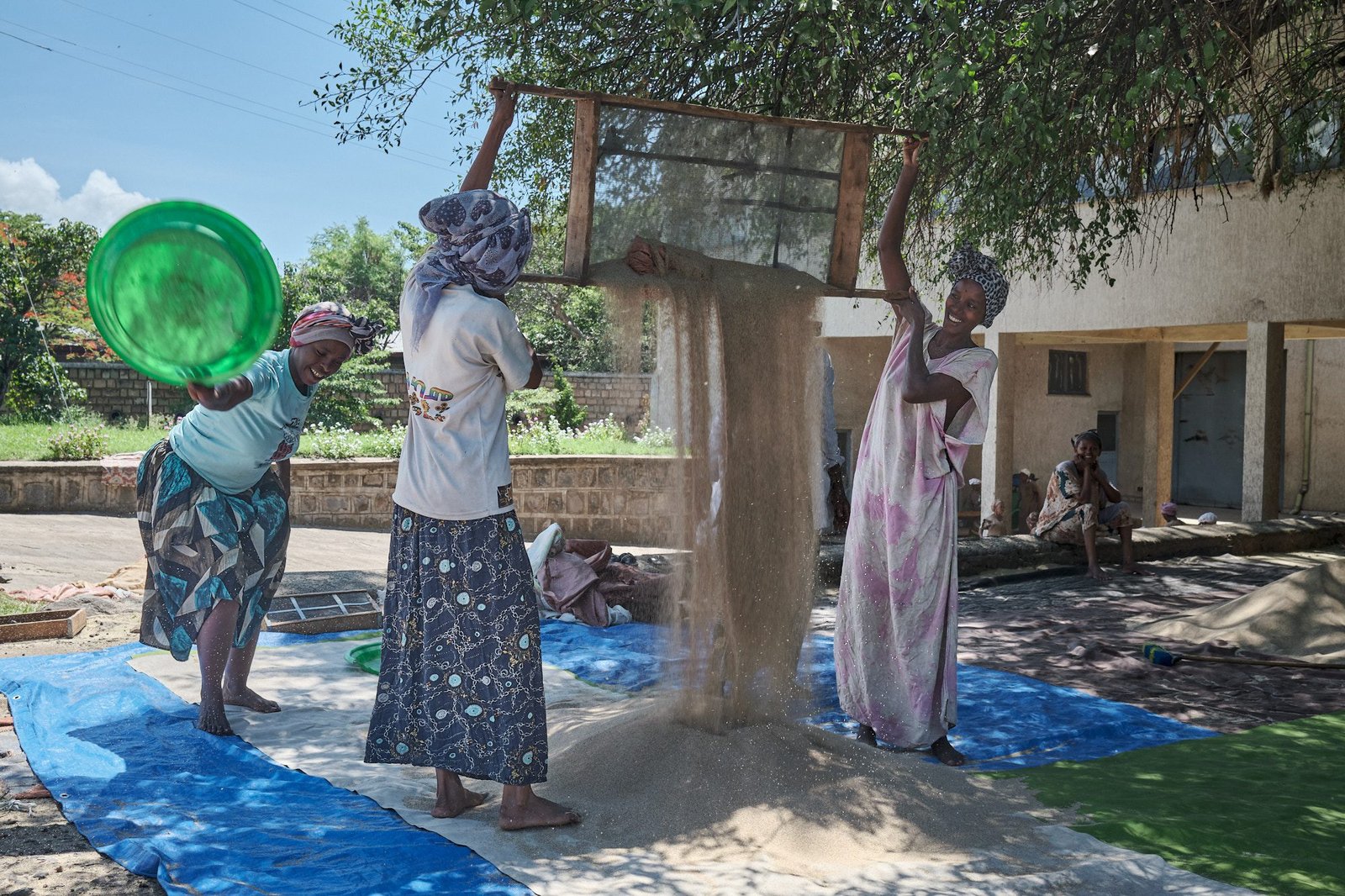
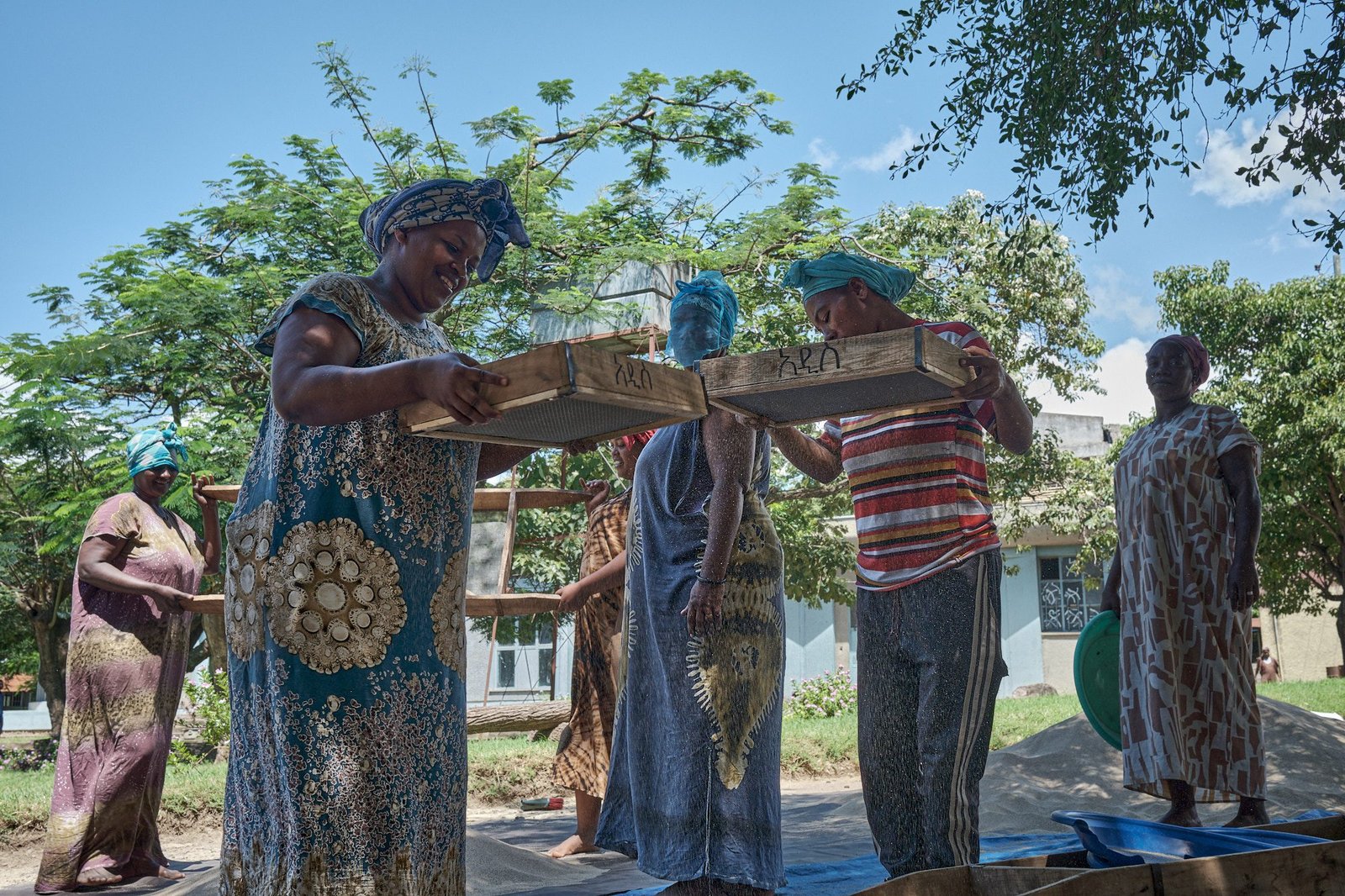
The work begins with a lift. Two women raise a wooden sieve between them. A third waits with a basin. Fine particles fall in a pale curtain. The air fills for a moment, then clears. Under the trees, the flour lands softly on tarps spread across the ground. Nothing in the scene is hurried. Each movement has already been learned by repetition.
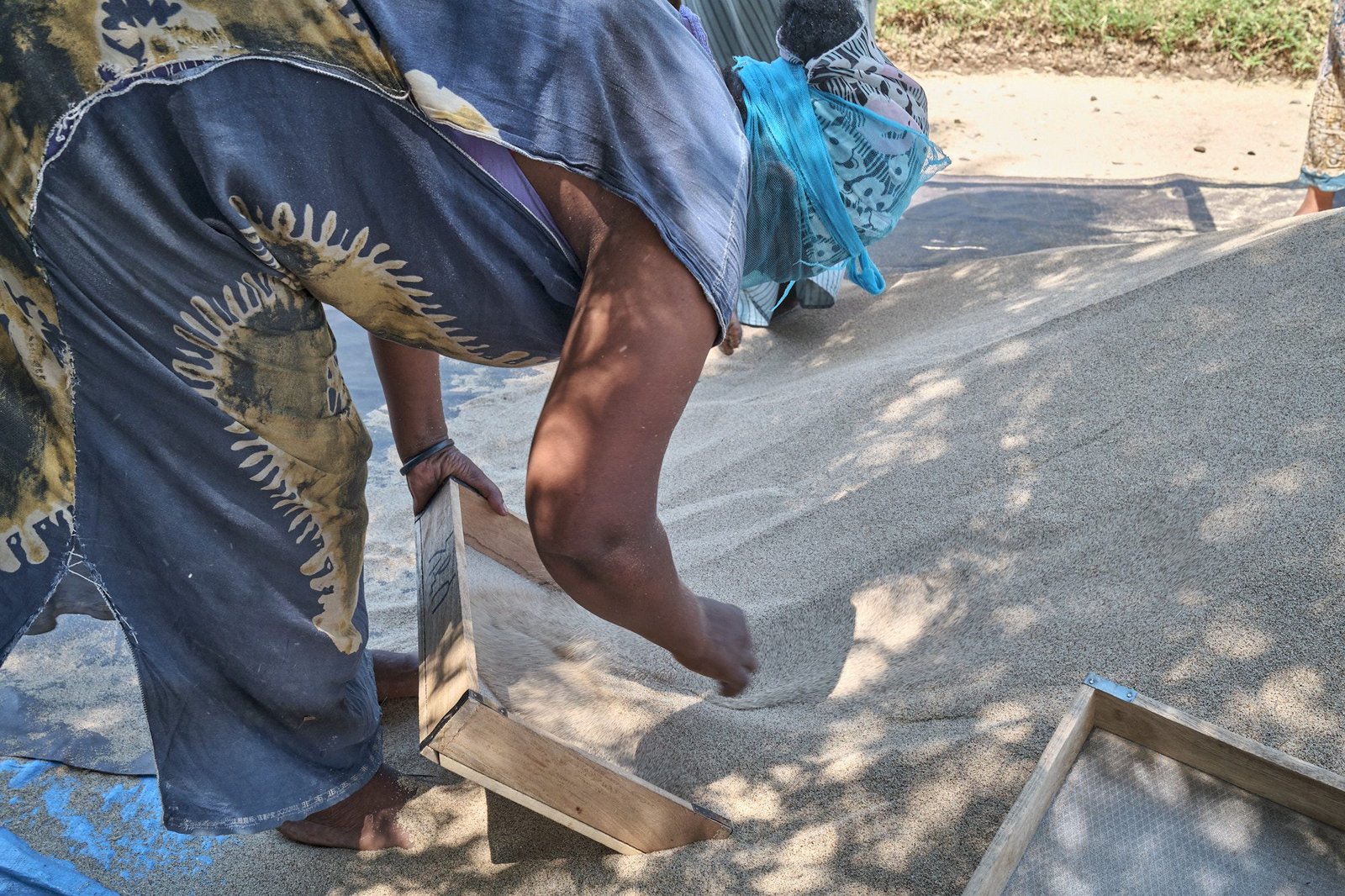
Another woman bends over the mound and draws the flour toward her with a shallow tray. One shakes. One catches. One watches for stones, husks, clumps, the smallest interruption in texture. Around them, there is conversation, shade, bare feet, patterned cloth, the ordinary precision of shared work.
At the center of the table
These photographs matter because they place teff in its proper setting: a food handled in common, refined through shared attention, and prepared for the table in full view of others. The flour passes from tray to sieve, from sieve to tarp, from tarp to bowl, and from bowl, later, to the batter that will become injera.
Each transfer seems small. Together they form a chain of care. One woman lifts, another steadies, another watches texture and weight. The work belongs to many hands before it reaches a meal.
Teff sits at the center of Ethiopian food culture. Native to Ethiopia and Eritrea, it remains one of Ethiopia’s most important staple grains and one of the strongest continuities between field, kitchen, and table. Its flour is used extensively to make injera, the soft, slightly sour flatbread that anchors meals across the country.
Injera carries stews, gathers families and guests around a common tray, and gives the meal its structure and rhythm. These images stay close to that reality. They show the food before the bread, and the bread before the shared meal.
A staple shaped by daily use
Injera changes the shape of a meal. It lies on the tray first. Stews, lentils, vegetables, and sauces arrive after. Pieces are torn by hand and used to lift the food. The bread serves as base, utensil, and final bite. It absorbs spice, heat, oil, and time. At the table, teff becomes texture and rhythm.
That daily role gives the flour its real scale. Teff is not marginal in Ethiopia. It belongs to habit. Reviews of Ethiopian food systems describe injera as a traditional staple prepared usually from teff flour and consumed every day in many households. The grain remains deeply tied to both nourishment and household routine.
A staple food always carries more than calories. It carries memory, expectation, and a set of skills passed across generations. How long to let batter rest. How thinly to pour. How to read heat by sound and smell. How to judge flour between the fingers. In that sense, teff belongs as much to practice as to agriculture.
Why teff has endured
Teff is tiny. That fact changes everything. Its grains are so small that when they are milled, the bran and germ generally remain with the flour. Teff flour is therefore usually consumed as a whole-grain flour.
That gives it a nutritional profile that people have valued for a long time in everyday use and that food science has described more carefully in recent decades.
The grain is naturally gluten-free. That makes it important for people with celiac disease and for gluten-free food production more broadly.
Outside Ethiopia, this point often receives the most attention. Inside Ethiopia, it sits alongside older and more practical reasons for eating teff: familiarity, taste, satiety, and the quality of the injera it produces.
The strength of a staple
Teff is also recognized as a good source of dietary fiber and protein. Reviews describe it as relatively rich in lysine compared with many other cereals, and they note meaningful levels of minerals including calcium, iron, and magnesium.
The exact nutritional values vary by variety, soil, and processing, so the strongest claims should stay measured. Still, the broad picture is consistent across reputable sources: teff is a nutrient-dense grain with clear dietary value.
This helps explain its endurance. A grain stays in the center of a food culture because it works. It satisfies hunger. It stores well. It can be milled, fermented, shared, and eaten day after day without fatigue. Teff has done that work for centuries in the Horn of Africa.
Teff now travels far beyond Ethiopia
Its naturally gluten-free profile has opened markets in Europe and North America for breads, flour blends, and pasta, including Italian gluten-free products made with teff. Ethiopia partially reopened teff flour exports in 2015, after years of restrictions linked to domestic food security and price pressure.
That growing demand also produced a legal battle: a Dutch company, operating through a 2005 access-and-benefit-sharing agreement, tried to secure exclusive rights around the processing of teff flour for foreign markets. The effort became a cautionary case in the politics of food and origin.
In 2019, a Dutch court struck down two related patents for lack of inventive step. What remained after that was larger than a commercial dispute: a clear reminder that when a staple food enters global health markets, questions of ownership, attribution, and fair benefit-sharing move with it.
Flour, water, time
Flour alone does not make injera. The batter needs water, patience, and fermentation. Traditional injera is prepared from a slightly fermented batter, and that fermentation gives the bread its sour note, its flexibility, and its characteristic surface of small holes. What reaches the table begins much earlier, in bowls left to rest and transform.
Fermentation also matters nutritionally. Research on teff and injera notes that the process can reduce some anti-nutritional factors, including phytates, which otherwise limit the absorption of certain minerals. The bread that emerges from this process is more than ground grain cooked on heat. It is grain altered by microbial life, by timing, by accumulated knowledge.
In the photographs from Arba Minch, that longer process is easy to imagine. The women are still in the stage of refinement. The flour is being cleaned, loosened, made ready. Yet even here the future bread is already present. It exists in the care given to texture. It exists in the refusal to rush.
Teff in the Ethiopian diet
Teff’s best-known form is injera, but its place in Ethiopian food extends beyond one bread. Reference sources describe teff grains and flour in porridges, stews, and other traditional preparations, and broader reviews of teff note its use in several food and drink forms. This versatility matters. A staple grain becomes more resilient when it can move across meals, ages, and needs.
Injera remains the emotional and practical center. It is the bread that receives *wot*. It is the bread that gathers a meal into one circle. It is the bread associated with hospitality and closeness. The act of eating from a common platter gives the meal a social form that individual servings do not provide. Bread here supports relation as much as appetite.
That social dimension is easy to miss when teff is discussed only through export markets or health-food language. A grain can be gluten-free and culturally dense at the same time. Teff proves that point with unusual clarity. It belongs to the body, and it also belongs to the table as a shared space.
Value and pressure
A staple can also be expensive. FAO analyses of the Ethiopian teff sector note that teff is widely preferred, yet its consumption is shaped by price and income. Urban households with greater purchasing power often consume more of it, while lower-income households may turn more often to cheaper cereals or blend teff with other flours. Preference alone does not erase economic pressure.
That tension is part of the story and should stay visible. Teff is loved in Ethiopia, but love does not place it equally within reach for everyone at all times. Food systems carry hierarchy inside them: land, markets, transport, price shocks, urban demand. A grain can be central to national food culture and still be unevenly distributed across households.
This is one reason the photographs from Arba Minch feel important. They return the conversation to labor. Before teff becomes a market category, it remains a material that people handle together. The value begins there.
What the photographs teach
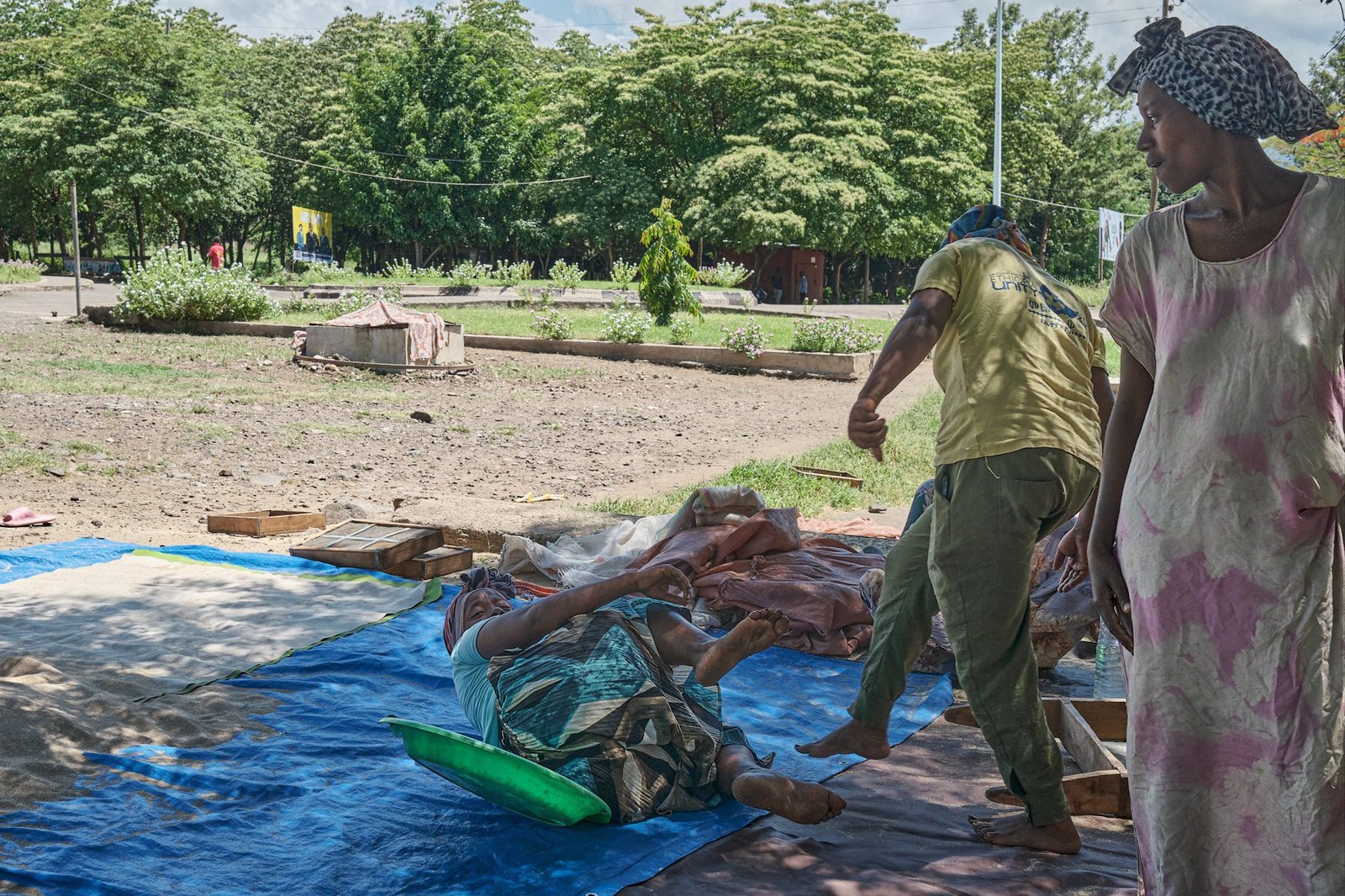
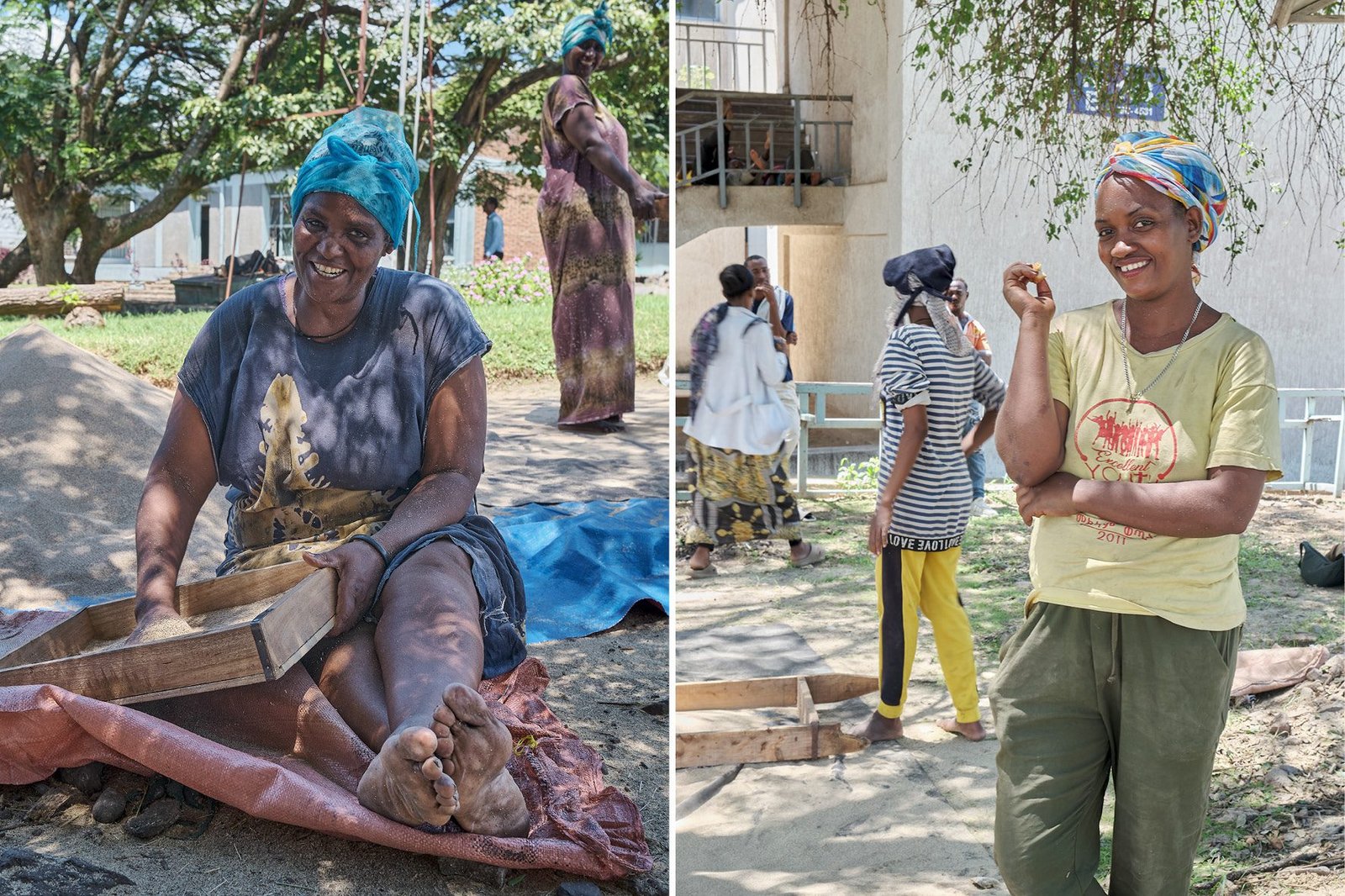
The images do not ask for spectacle. They offer work, coordination, and light. A sieve rises. Dust drifts. A woman steadies the frame with both hands. Another tilts a bright green tray. Someone stands back for a moment and smiles. Someone else watches the fall of flour with full concentration. The gestures are ordinary. Their accumulation gives them force.
Food writing often reaches too quickly for symbolism. These photographs resist that temptation. They stay close to task. They show a food culture at the point where care is visible. The flour is being prepared, but the scene also prepares the reader. It teaches scale. It teaches patience. It teaches that staple foods are built by repeated acts that rarely enter the final praise.
In that sense, the women in these frames are doing more than cleaning flour. They are holding together a chain that runs from grain to batter, from batter to injera, from injera to the shared meal. The work is practical. Its meaning is large.
The smallest grain, the widest reach
Teff has become internationally legible through the language of wellness. Much of that language is rooted in real qualities: whole-grain flour, no gluten, useful protein, substantial fiber, notable mineral content. Yet the grain becomes easier to understand when those qualities are placed back inside Ethiopian life, where teff has long been food before it became label.
In Ethiopia, teff remains close to use. It is milled. It is sifted. It is mixed with water and left to ferment. It becomes injera, and injera becomes the ground of the meal. That sequence gives the grain its real authority. Nutrition matters. Taste matters. Daily dependence matters too.
So does dignity in work
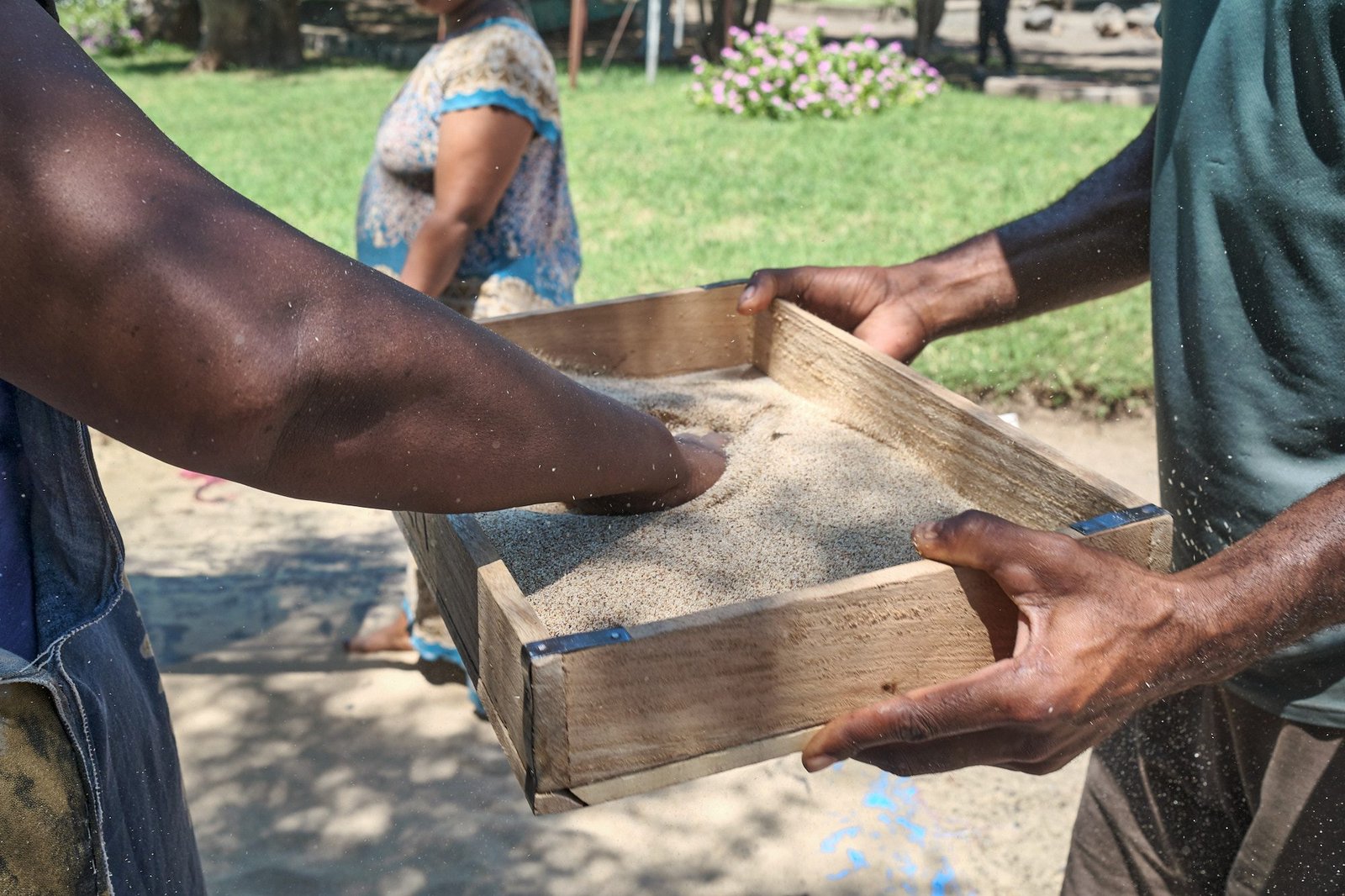
Under the trees in Arba Minch, the flour falls in a narrow, shining stream. A wooden sieve moves forward and back. A tray catches what is ready. Another pass begins.
By the time teff reaches the table, much of this labor will be invisible. The bread will look simple. The meal will feel complete. The photographs restore the missing middle. They show what the flour carries on its way there.